In the realm of manufacturing and quality control, precision and accuracy are paramount. Checking fixtures and Coordinate Measuring Machine (CMM) fixtures play a crucial role in ensuring that parts meet the required specifications. Among the various types of checking methods, 2D and 3D checking stand out as two distinct approaches, each with its own set of characteristics and applications. As a supplier of Checking And CMM Fixtures, I have witnessed firsthand the differences between 2D and 3D checking and the unique roles that CMM fixtures play in the process. In this blog post, I will delve into the intricacies of 2D and 3D checking, explore the functions of CMM fixtures, and highlight the key differences between them.
Understanding 2D Checking
2D checking is a traditional method used to verify the dimensional accuracy of parts in two dimensions, typically on a flat surface. It involves comparing the actual dimensions of a part against a predefined set of tolerances using measuring tools such as calipers, micrometers, and height gauges. This method is relatively simple and cost - effective, making it suitable for applications where only basic dimensional information is required.
One of the primary advantages of 2D checking is its simplicity. Operators can quickly learn how to use the measuring tools and perform the checks, which reduces the training time and labor costs. Additionally, 2D checking is often faster than 3D checking, as it only focuses on a limited number of dimensions. This makes it ideal for high - volume production environments where quick feedback on part quality is essential.
However, 2D checking has its limitations. It provides only a two - dimensional view of the part, which means that it may not detect issues related to the part's shape, form, or orientation in three - dimensional space. For example, a part may have a perfect 2D profile but still have a warped surface or incorrect curvature that can affect its functionality. Moreover, 2D checking is highly dependent on the operator's skill and accuracy, as human error can easily lead to incorrect measurements.
Exploring 3D Checking
In contrast to 2D checking, 3D checking provides a comprehensive view of a part's geometry in three - dimensional space. It uses advanced measuring technologies such as coordinate measuring machines (CMMs), laser scanners, and structured light scanners to capture the part's surface data and compare it against a digital model. This allows for the detection of even the most subtle deviations from the design specifications, including shape errors, surface roughness, and positional accuracy.
One of the key benefits of 3D checking is its high level of accuracy and precision. CMMs, for instance, can measure parts with extremely high resolution, often down to a few micrometers. This makes 3D checking suitable for applications where tight tolerances are required, such as aerospace, automotive, and medical device manufacturing. Additionally, 3D checking can provide detailed information about the part's surface topology, which can be used for reverse engineering, process optimization, and quality control.
Another advantage of 3D checking is its ability to generate detailed reports and visualizations. The measured data can be presented in the form of 3D models, color - coded maps, and statistical analyses, which makes it easier for engineers and quality control personnel to understand the part's quality and identify areas for improvement.
However, 3D checking also has some drawbacks. It is generally more expensive than 2D checking, both in terms of equipment cost and operating expenses. CMMs and other 3D measuring devices require significant investment, and they also need regular calibration and maintenance to ensure accurate results. Moreover, 3D checking is often more time - consuming than 2D checking, especially for complex parts, as it involves capturing and processing a large amount of data.


The Role of CMM Fixtures
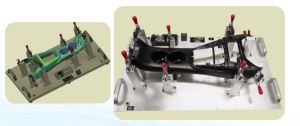
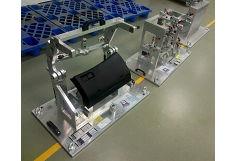
CMM fixtures are essential components in both 2D and 3D checking processes, especially when using coordinate measuring machines. Their primary function is to hold the part in a fixed position and orientation during the measurement process, ensuring that accurate and repeatable measurements can be obtained.
CMM fixtures are designed to be highly precise and rigid. They are typically made from materials such as aluminum, steel, or granite, which have low thermal expansion coefficients and high stiffness. This helps to minimize the effects of temperature changes and vibrations on the measurement accuracy.
In 2D checking, CMM fixtures can be used to position the part correctly on the measuring surface, allowing for accurate measurement of the 2D dimensions. For example, a simple fixture can hold a flat part in place while a caliper or height gauge is used to measure its length, width, and height.
In 3D checking, CMM fixtures play an even more critical role. They need to hold the part in a way that allows the CMM probe or scanner to access all the relevant surfaces of the part without any interference. This may involve using complex multi - axis fixtures or custom - designed fixtures that are tailored to the specific shape and geometry of the part. For instance, a fixture for a turbine blade may need to hold the blade at multiple angles to ensure that all the curved surfaces can be measured accurately.
Key Differences between 2D and 3D Checking and CMM Fixtures
Dimensional Scope
The most obvious difference between 2D and 3D checking is the dimensional scope. 2D checking focuses on two dimensions, while 3D checking covers three dimensions. CMM fixtures need to be designed accordingly. For 2D checking, fixtures can be relatively simple, as they only need to hold the part in a flat position. In 3D checking, fixtures must be more complex to accommodate the part's three - dimensional shape and allow for full access to all surfaces.
Accuracy Requirements
3D checking generally requires a higher level of accuracy than 2D checking. This means that CMM fixtures used in 3D checking need to be more precise and have better repeatability. They need to hold the part with minimal movement or deformation to ensure that the CMM can measure the part's geometry accurately. In contrast, fixtures for 2D checking can tolerate a slightly higher degree of error, as the measurements are less sensitive to small variations in the part's position.
Complexity of Fixture Design
The complexity of CMM fixture design also varies between 2D and 3D checking. 2D checking fixtures are often simpler and easier to design, as they do not need to account for the part's three - dimensional shape. They can be based on standard designs or modified slightly to fit the part's basic dimensions. On the other hand, 3D checking fixtures may require custom design and engineering, especially for complex parts. The fixture design needs to consider factors such as the part's access points, the movement of the CMM probe, and the need to avoid interference with the part's features.
Cost
Cost is another significant difference. 2D checking is generally more cost - effective than 3D checking, both in terms of the measuring tools and the fixtures. 2D measuring tools are less expensive, and the fixtures can be made from simpler materials and with less precision. In contrast, 3D checking requires expensive equipment such as CMMs, and the CMM fixtures also need to be of higher quality, which increases the overall cost.
Conclusion
In conclusion, 2D and 3D checking are two distinct methods with their own advantages and limitations, and CMM fixtures play a crucial role in both processes. 2D checking is simple, fast, and cost - effective, making it suitable for basic dimensional verification in high - volume production. 3D checking, on the other hand, offers high accuracy and comprehensive geometric information, but it is more expensive and time - consuming.
As a supplier of Checking And CMM Fixtures, we understand the unique requirements of different industries and applications. Whether you need a simple 2D checking fixture or a complex 3D CMM fixture, we can provide you with high - quality solutions tailored to your specific needs. If you are interested in our Checking Fixtures or Checking Fixture And Gages, please feel free to contact us for a detailed discussion and procurement negotiation. We are committed to helping you improve your quality control processes and achieve greater precision in your manufacturing operations.
References
- "Fundamentals of Dimensional Metrology" by John Z. Pandian.
- "Coordinate Measuring Machines: Principles, Design, and Applications" by Y. R. Mayya.
- Industry whitepapers on quality control in manufacturing.