Hey there! As a supplier of Checking And CMM Fixtures, I've had my fair share of experiences in this industry. Today, I'm gonna share with you how to evaluate the performance of these fixtures. It's super important, whether you're a manufacturer looking to buy or someone already using them.
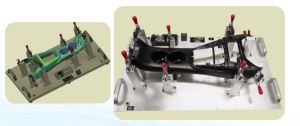
First off, let's talk about what checking fixtures and CMM fixtures are. Checking fixtures are used to quickly verify the dimensional accuracy of parts. They're like a quick snapshot of whether a part meets the required specs. On the other hand, CMM (Coordinate Measuring Machine) fixtures are designed to hold parts precisely during measurement on a CMM, which provides highly accurate 3D measurements. You can learn more about Checking Fixture And Gages.
Accuracy
Accuracy is the name of the game when it comes to evaluating these fixtures. The whole point of using them is to make sure parts are within the specified tolerances. For checking fixtures, you need to see how well they can detect deviations in part dimensions. A good way to do this is by using master parts with known dimensions. Place the master part in the checking fixture and see if the fixture indicates the correct results. If it's off, then there's an accuracy issue.
With CMM fixtures, accuracy is even more critical. Since CMMs are used for high - precision measurements, the fixture needs to hold the part in the exact position every time. Any movement or misalignment can lead to incorrect measurement results. You can test the accuracy of CMM fixtures by repeatedly measuring the same part on the CMM while it's held in the fixture. Calculate the variation in the measurements. If the variation is within an acceptable range, then the fixture is accurate enough.
Repeatability
Repeatability goes hand - in - hand with accuracy. A fixture that can't give consistent results over multiple uses is pretty much useless. For checking fixtures, repeatability means that every time you place a part in the fixture, it should give the same pass or fail indication. To test this, take a batch of identical parts and check them one by one in the fixture. If you get inconsistent results, there's a problem with the fixture's repeatability.
In the case of CMM fixtures, repeatability is about holding the part in the same position for each measurement. You can measure a part multiple times on the CMM with the fixture. If the measurements are close to each other, then the fixture has good repeatability. Poor repeatability can be caused by issues like loose clamping mechanisms or worn - out components in the fixture.
Ease of Use
Let's face it, if a fixture is a pain to use, no one's gonna want to work with it. Ease of use is an important factor in evaluating checking and CMM fixtures. For checking fixtures, it should be easy to load and unload parts. The indicators should be clear and easy to read. If the fixture has a lot of complex mechanisms that make it difficult to operate, it can slow down the inspection process.
CMM fixtures also need to be user - friendly. They should be easy to install on the CMM table and easy to position the part in. If the fixture requires a lot of setup time or special tools to use, it can increase the overall measurement time and cost. So, when evaluating these fixtures, think about how easy they are for the operators to work with.
Durability
Fixtures are an investment, and you want them to last. Durability is a key aspect of evaluating checking and CMM fixtures. For checking fixtures, they are often used in high - volume production environments, where they can be subjected to a lot of wear and tear. The materials used in the fixture should be strong and resistant to damage. For example, if the fixture has pins or locators, they should be made of hard - wearing materials like hardened steel.
CMM fixtures also need to be durable. Since they are used for precision measurements, any damage to the fixture can affect the accuracy and repeatability. Check the construction of the fixture. Look for signs of weak joints or flimsy components. A well - built fixture will be able to withstand the rigors of regular use without losing its performance.
Compatibility
Compatibility is another important factor. Checking fixtures need to be compatible with the parts they are designed to check. They should be able to accommodate the part's shape, size, and features. If a checking fixture is only suitable for a very specific part and can't be easily modified for other similar parts, it may not be a good investment.
CMM fixtures need to be compatible with the CMM machine they are used with. They should fit properly on the CMM table and be able to work with the CMM's software and measurement system. Some CMM fixtures are designed to be modular, which means they can be easily adjusted or reconfigured to work with different parts or CMM models. This kind of compatibility can save a lot of time and money in the long run.
Cost - effectiveness
Cost is always a consideration. You don't want to overspend on a fixture, but at the same time, you can't sacrifice quality for a lower price. When evaluating checking and CMM fixtures, you need to look at the total cost of ownership. This includes the initial purchase price, as well as the cost of maintenance, calibration, and any potential downtime due to fixture issues.
A more expensive fixture may be worth it if it offers better accuracy, repeatability, and durability. On the other hand, a cheap fixture that breaks down frequently or gives inaccurate results can end up costing you more in the long run. So, do a cost - benefit analysis before making a decision.
As a supplier of Checking And CMM Fixtures, I understand the importance of these evaluation factors. We strive to provide fixtures that meet the highest standards in terms of accuracy, repeatability, ease of use, durability, compatibility, and cost - effectiveness.
If you're in the market for checking and CMM fixtures, especially for the automotive industry, you can check out our Checking Fixture For Automotive Industry. We'd love to have a chat with you about your specific needs and how our fixtures can help improve your production process. Whether you're looking for a new fixture or want to evaluate your existing ones, feel free to reach out and start a conversation. We're here to assist you in making the right choice for your business.


References
- "Manufacturing Metrology Handbook" by John H. Ziegert
- "Precision Measuring Instruments and Their Use" by William D. Callister Jr.
- Industry whitepapers on checking and CMM fixtures from leading manufacturers.