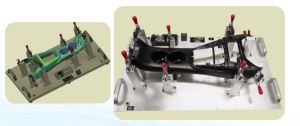
Ensuring the compatibility of checking fixtures with other inspection tools is crucial in the manufacturing industry. As a Checking Fixtures supplier, I've faced this challenge numerous times and have learned some effective strategies to make sure everything works seamlessly together.
First off, let's understand why compatibility matters. In a production environment, checking fixtures are used to verify the dimensions and features of parts. They often work in conjunction with other inspection tools like coordinate measuring machines (CMMs), gauges, and optical scanners. If these tools aren't compatible, it can lead to inaccurate measurements, wasted time, and even production delays.
One of the key steps in ensuring compatibility is communication. When a customer comes to me with a project, I make sure to have in - depth discussions about all the inspection tools they plan to use. This includes understanding the specifications of the CMM, the type of gauges, and any unique requirements of the optical scanners. For example, if a customer is using a high - precision CMM, I need to know its accuracy range, probe type, and software capabilities. This way, I can design the checking fixture to be fully compatible with the CMM's operating parameters.
I also keep a close eye on the industry standards. There are various international and national standards for inspection tools and fixtures. For instance, ISO standards provide guidelines on dimensional accuracy, surface finish, and material properties. By adhering to these standards, I can ensure that my checking fixtures are more likely to be compatible with other inspection tools that also follow these norms. When designing a checking fixture, I make sure that its design and manufacturing processes meet or exceed the relevant ISO standards. This helps in maintaining a high level of compatibility across different inspection setups.
Another important aspect is the use of common interfaces. Many inspection tools have standardized interfaces for connecting fixtures and other accessories. For example, some CMMs use a common mounting system for fixtures. By designing my checking fixtures with these common interfaces in mind, I can ensure easy integration with the CMM. This not only simplifies the setup process but also reduces the chances of compatibility issues. I also make sure that the checking fixtures can be easily adjusted to fit different types of inspection tools. This flexibility is key to ensuring compatibility in a variety of production environments.


Material selection also plays a significant role in compatibility. Different inspection tools may have different requirements for the materials used in the checking fixtures. For example, some optical scanners may be sensitive to the reflectivity of the fixture material. In such cases, I choose materials with low reflectivity to avoid interference with the scanning process. Additionally, the material should be stable and have minimal thermal expansion to ensure accurate measurements over time. I usually opt for high - quality metals or composites that offer good dimensional stability and can withstand the rigors of the inspection process.
Software compatibility is another area that can't be overlooked. Many modern inspection tools are controlled by sophisticated software. My checking fixtures need to be compatible with the software used by the customer's inspection tools. This may involve ensuring that the fixture's design can be imported into the inspection software without any issues. I also work closely with software developers to make sure that the fixture's data can be accurately processed and analyzed by the inspection software. This way, the entire inspection process can be automated and streamlined, improving efficiency and accuracy.
Testing is an essential part of the process. Before delivering a checking fixture to a customer, I conduct thorough testing using the customer's inspection tools or similar tools in my own facility. This allows me to identify and address any compatibility issues early on. For example, I may test the fixture with a CMM to check its accuracy and repeatability. I also test the fixture's compatibility with gauges and other hand - held inspection tools. By conducting these tests, I can fine - tune the fixture's design and make any necessary adjustments to ensure full compatibility.
In addition to these technical aspects, I also provide comprehensive training and support to my customers. When a customer purchases a checking fixture from me, I offer training on how to use the fixture in conjunction with their other inspection tools. I also provide ongoing technical support to help them resolve any compatibility issues that may arise during the course of their production. This hands - on approach ensures that my customers can get the most out of their inspection tools and checking fixtures.
As a Checking Fixtures supplier, I understand the importance of ensuring compatibility with other inspection tools. By focusing on communication, industry standards, common interfaces, material selection, software compatibility, testing, and customer support, I can provide high - quality checking fixtures that work seamlessly with a wide range of inspection tools. If you're in the market for Checking Fixtures, or if you're looking for a Checking Fixture Supplier In China, or need Checking Fixtures CMM Holding Fixtures And Gauges, I'd love to talk to you. Feel free to reach out to discuss your specific requirements and how we can work together to ensure the best inspection solutions for your production needs.
References
- International Organization for Standardization (ISO). Various ISO standards related to inspection tools and fixtures.
- Industry whitepapers on inspection technology and fixture design.