In the realm of manufacturing, ensuring the accuracy and quality of parts is of paramount importance. Checking fixtures and Coordinate Measuring Machine (CMM) fixtures play a crucial role in this process. As a supplier of Checking And CMM Fixtures, I have witnessed firsthand the significance of these tools and the design principles that underpin their effectiveness.
Understanding Checking and CMM Fixtures
Before delving into the design principles, it's essential to understand what checking and CMM fixtures are and their respective functions.
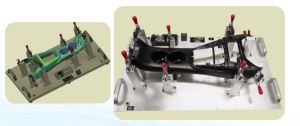
Checking fixtures are specialized tools used to verify the dimensional accuracy and geometric characteristics of manufactured parts. They are designed to simulate the assembly environment and provide a quick and reliable way to check if a part meets the specified tolerances. Checking fixtures are commonly used in mass production environments where high-speed inspection is required.


On the other hand, CMM fixtures are used to hold parts securely during measurement on a Coordinate Measuring Machine. A CMM is a precision instrument that can measure the dimensions of a part with high accuracy. CMM fixtures are designed to ensure that the part is positioned correctly and remains stable during the measurement process, thereby minimizing measurement errors.
Design Principles of Checking Fixtures
1. Functionality
The primary design principle of a checking fixture is functionality. It must be able to accurately measure the critical dimensions and geometric features of the part. This requires a thorough understanding of the part's design requirements and the manufacturing process. The fixture should be designed to provide clear and unambiguous measurement results, allowing operators to quickly determine if a part is within the acceptable tolerance range.
For example, when designing a Checking Fixture For Plastic Parts, the fixture must be able to account for the unique properties of plastic materials, such as their flexibility and tendency to deform under stress. The fixture should be designed to hold the part firmly without causing excessive deformation, ensuring accurate measurement.
2. Repeatability
Repeatability is another crucial design principle. A checking fixture should produce consistent measurement results over multiple uses. This requires precise manufacturing and assembly techniques to ensure that the fixture's components are accurately positioned and aligned. Additionally, the fixture should be designed to minimize the effects of wear and tear, ensuring long-term reliability.
To achieve repeatability, the fixture may incorporate features such as precision locating pins, bushings, and clamping mechanisms. These components help to ensure that the part is always positioned in the same way, reducing measurement variability.
3. Ease of Use
A checking fixture should be easy to use, even for operators with limited training. It should have a clear and intuitive design, with well-labeled measurement points and indicators. The fixture should also be easy to load and unload parts, minimizing the time and effort required for inspection.
For example, a well-designed checking fixture may have a simple clamping mechanism that allows operators to quickly secure the part in place. It may also have a built-in lighting system to improve visibility, making it easier to read the measurement results.
4. Durability
Durability is essential for a checking fixture, especially in high-volume production environments. The fixture should be able to withstand the rigors of daily use without significant wear or damage. This requires the use of high-quality materials and robust construction techniques.
Common materials used in the construction of checking fixtures include steel, aluminum, and plastic. The choice of material depends on the specific requirements of the application, such as the size and weight of the part, the measurement accuracy required, and the operating environment.
Design Principles of CMM Fixtures
1. Precision Location
The most critical design principle of a CMM fixture is precision location. The fixture must be able to position the part accurately in the CMM's coordinate system, ensuring that the measurement results are reliable. This requires the use of precision locating features, such as dowel pins, V-blocks, and surface plates.
The locating features should be designed to minimize the effects of part variation and ensure that the part is always positioned in the same way. Additionally, the fixture should be designed to allow for easy adjustment and alignment, ensuring that the part can be accurately positioned even if there are minor variations in the part's dimensions.
2. Stability
Stability is another important design principle for CMM fixtures. The fixture must be able to hold the part securely during the measurement process, minimizing the effects of vibration and movement. This requires a rigid and robust design, with a low center of gravity and a large contact area between the fixture and the part.
The fixture may also incorporate features such as anti-vibration pads and damping materials to further reduce the effects of vibration. Additionally, the clamping mechanism should be designed to apply a uniform and consistent force, ensuring that the part remains stable during the measurement process.
3. Compatibility
A CMM fixture should be compatible with the specific CMM being used. This includes considerations such as the size and shape of the CMM's measuring volume, the type of probe being used, and the software interface. The fixture should be designed to allow for easy integration with the CMM, ensuring that the measurement process is efficient and accurate.
For example, some CMMs may require a specific type of fixture mounting system, such as a T-slot table or a grid plate. The fixture should be designed to be compatible with these mounting systems, allowing for quick and easy installation and removal.
4. Modularity
Modularity is a desirable design principle for CMM fixtures, especially in applications where multiple parts need to be measured. A modular fixture system allows for the easy customization and reconfiguration of the fixture, reducing the need for multiple dedicated fixtures.
A modular CMM fixture may consist of a base plate with a series of standardized mounting holes and slots. The fixture components, such as locating pins, clamps, and supports, can be easily attached and detached from the base plate, allowing for the quick setup and adjustment of the fixture for different parts.
The Role of a Checking Fixture Supplier In China
As a Checking Fixture Supplier In China, we understand the importance of these design principles and strive to incorporate them into every fixture we produce. We have a team of experienced engineers and designers who work closely with our customers to understand their specific requirements and develop customized solutions.
We use state-of-the-art manufacturing equipment and techniques to ensure the highest level of precision and quality in our fixtures. Our manufacturing process includes precision machining, heat treatment, surface finishing, and assembly, all of which are carried out in strict accordance with international standards.
In addition to our technical expertise, we also offer excellent customer service. We provide comprehensive support throughout the entire project lifecycle, from initial design and prototyping to final production and installation. We are committed to ensuring that our customers are satisfied with our products and services, and we are always available to answer any questions or address any concerns.
Conclusion
The design principles of checking and CMM fixtures are essential for ensuring the accuracy, reliability, and efficiency of the inspection process. By following these principles, we can develop fixtures that meet the specific needs of our customers and help them to improve the quality of their products.
If you are in the market for high-quality Checking Fixtures CMM Holding Fixtures And Gauges, we invite you to contact us to discuss your requirements. Our team of experts will be happy to work with you to develop a customized solution that meets your needs and budget.
References
- ASME Y14.5 - Dimensioning and Tolerancing Standard
- ISO 10360 - Geometrical Product Specifications (GPS) - Acceptance and reverification tests for coordinate measuring machines (CMMs)
- Manufacturing Engineering Handbook, Edited by Myer Kutz