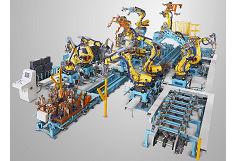
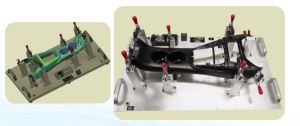
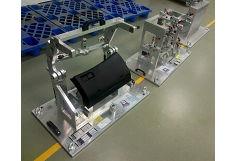
Hey there! As a supplier of Robotic MIG Weld Fixtures, I've been in the thick of the welding game for quite a while. One question that comes up time and time again is, "How to measure the welding quality of a Robotic MIG Weld Fixture?" Well, I'm here to break it down for you in plain English.
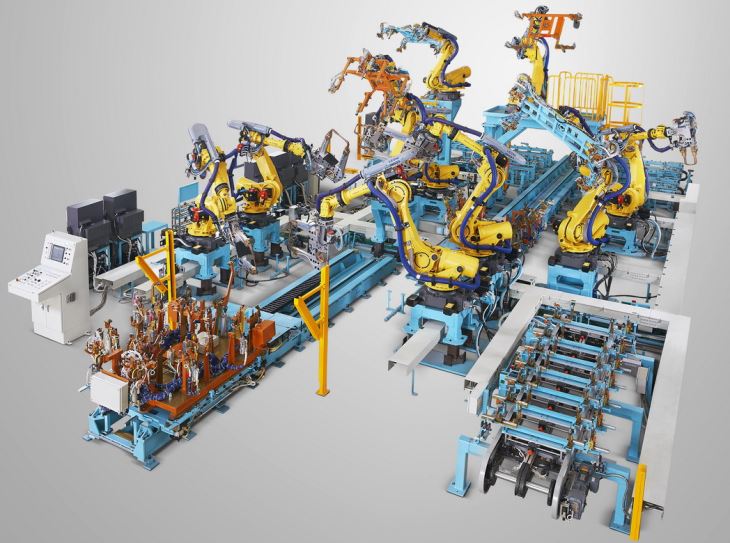
First off, let's talk about why measuring welding quality is so important. A high - quality weld is crucial for the structural integrity and performance of the final product. Whether it's an Auto Pillar Parts Welding Fixture used in the automotive industry or a Robotic Welding Fixture Line for mass production, a shoddy weld can lead to all sorts of problems, from premature failure to safety hazards.
Visual Inspection
The first and simplest way to measure welding quality is through visual inspection. It's like taking a good look at a painting to see if there are any obvious flaws. When you're looking at a weld made with a Robotic MIG Weld Fixture, you want to check for things like proper bead shape. A good weld bead should be smooth, uniform, and have consistent width and height. If the bead looks lumpy, has uneven edges, or shows signs of spatter, that's a red flag.
Spatter is those little bits of molten metal that fly off during the welding process. While a little bit of spatter is normal, excessive spatter can indicate issues with the welding parameters, like incorrect voltage or wire feed speed. You also want to check for undercutting, which is when the base metal is melted away along the edges of the weld bead, leaving a groove. Undercutting weakens the weld and can lead to stress concentration points.
Penetration Depth
Another key aspect of welding quality is penetration depth. This is how deep the weld goes into the base metal. You can think of it as how well the glue (the weld) is sticking to the pieces you're trying to join. For a good weld, the penetration depth should be sufficient to ensure a strong bond. If the penetration is too shallow, the weld might not hold up under stress. On the other hand, if it's too deep, it can cause distortion of the base metal.
Measuring penetration depth can be a bit tricky. One way is to use destructive testing, where you cut a cross - section of the weld and measure it under a microscope. But this isn't always practical, especially if you're dealing with a large production run. Non - destructive methods, like ultrasonic testing, can also be used to estimate penetration depth. Ultrasonic waves are sent through the weld, and the way they bounce back can give you an idea of the internal structure of the weld, including penetration depth.
Hardness Testing
Hardness testing is another useful method for measuring welding quality. The hardness of a weld can tell you a lot about its strength and ductility. After welding, the heat - affected zone (HAZ) around the weld can have different hardness properties compared to the base metal. If the hardness in the HAZ is too high, it can make the area brittle and more prone to cracking. If it's too low, the weld might not be strong enough.
There are several ways to test hardness, such as the Rockwell or Brinell hardness tests. These tests involve pressing an indenter into the weld or HAZ with a specific amount of force and measuring the size of the indentation. The smaller the indentation, the harder the material. By comparing the hardness of the weld and the HAZ to the base metal, you can get an idea of how well the welding process has affected the material properties.
X - Ray and Gamma - Ray Testing
For more in - depth inspection, X - ray and gamma - ray testing can be used. These methods are great for detecting internal defects in the weld, like porosity (tiny holes in the weld) or cracks that aren't visible on the surface. X - rays and gamma rays can penetrate the weld and create an image on a film or digital detector.
Porosity can be a major issue in MIG welding. It's often caused by contaminants in the shielding gas, improper gas flow, or moisture in the base metal or welding wire. Cracks, on the other hand, can be due to factors like rapid cooling, high residual stresses, or improper joint design. By using X - ray or gamma - ray testing, you can catch these internal defects early and take corrective action before the product goes out the door.
Tensile and Bend Testing
Tensile and bend testing are also important for evaluating the mechanical properties of a weld. Tensile testing involves pulling a welded sample until it breaks. The maximum load the sample can withstand before breaking is called the tensile strength. A good weld should have a tensile strength that's close to or equal to the strength of the base metal.
Bend testing, on the other hand, involves bending the welded sample to see how well it can withstand deformation. If the weld cracks or separates during the bend test, it indicates poor ductility and a weak bond. These tests can help you determine if the weld made with a Robotic MIG Weld Fixture is strong enough for its intended application.
Welding Parameters Monitoring
In addition to these testing methods, monitoring the welding parameters during the process is crucial. The Robotic MIG Weld Fixture is programmed to control things like voltage, current, wire feed speed, and gas flow rate. These parameters need to be set correctly to ensure a high - quality weld.
For example, if the voltage is too high, the arc will be too hot, which can cause excessive spatter and burn - through. If the wire feed speed is too slow, the weld might not have enough filler metal, resulting in a weak joint. By continuously monitoring these parameters and making adjustments as needed, you can maintain consistent welding quality.
Quality Control Systems
To ensure that all these quality measurements are carried out effectively, it's a good idea to have a comprehensive quality control system in place. This can include regular inspections at different stages of the production process, from the initial setup of the Robotic MIG Weld Fixture to the final testing of the welded products.
You can use statistical process control (SPC) techniques to analyze the data collected from the various quality measurements. SPC helps you identify trends and patterns in the welding process, so you can take proactive measures to prevent quality issues before they occur. For example, if you notice that the penetration depth is gradually decreasing over time, you can adjust the welding parameters to bring it back to the desired level.
Conclusion
Measuring the welding quality of a Robotic MIG Weld Fixture is a multi - faceted process. It involves a combination of visual inspection, testing for penetration depth, hardness, and mechanical properties, as well as monitoring the welding parameters. By using these methods and having a solid quality control system in place, you can ensure that the welds produced by your Robotic MIG Weld Fixture are of the highest quality.
If you're in the market for a Robotic MIG Weld Fixture or need more information about measuring welding quality, don't hesitate to reach out. We're here to help you make the best decisions for your welding needs and ensure that you get the most out of your investment. Let's have a chat and see how we can work together to improve your welding processes and product quality.
References
- Welding Handbook, American Welding Society
- Principles of Welding, John Wiley & Sons
- Quality Control in Welding, ASME Press