Hey there! As a supplier of Checking And CMM Fixtures, I often get asked about how these nifty tools work. So, I thought I'd take a few minutes to break down the working principle of checking and CMM fixtures for you.
Let's start with checking fixtures. A checking fixture is a custom-made device used to verify the dimensional accuracy and geometric characteristics of a part. Think of it as a super precise detective that can tell you if a part is up to snuff or if it's got some issues.
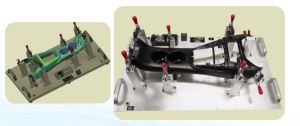
The basic idea behind a checking fixture is pretty straightforward. It's designed to replicate the ideal shape and dimensions of the part it's meant to check. When you place a part into the checking fixture, it fits snugly into specific areas that are machined to the exact specifications of the part. If the part is within the acceptable tolerance range, it will fit properly, and you'll get a thumbs up. But if it's out of spec, it might not fit at all, or it'll fit with some noticeable gaps or interference.
For example, let's say you're manufacturing plastic parts for the automotive industry. You can use a Checking Fixture For Plastic Parts to make sure each part meets the strict quality standards. The fixture will have pins, locators, and gauges that correspond to the critical features of the plastic part. When you place the part in the fixture, these elements will interact with the part, and you can quickly determine if the part is good or bad.
One of the key components of a checking fixture is the locator system. Locators are used to position the part accurately within the fixture. They can be in the form of pins, cones, or other geometric shapes that match the mating features of the part. By using a precise locator system, you can ensure that the part is held in the correct position every time, which is crucial for accurate measurement.
Another important aspect of checking fixtures is the use of gauges. Gauges are used to measure specific dimensions or features of the part. They can be simple go/no-go gauges, which give a binary result (either the part passes or fails), or more complex measuring gauges that provide precise numerical values. For instance, a go/no-go gauge might be used to check the diameter of a hole in a part. If the hole is within the acceptable size range, the gauge will fit through the hole; otherwise, it won't.
Now, let's move on to CMM fixtures. CMM stands for Coordinate Measuring Machine, and a CMM fixture is used to hold a part securely in place during measurement on a CMM. A CMM is a highly accurate measuring device that can measure the dimensions and geometry of a part in three dimensions.
The working principle of a CMM fixture is similar to that of a checking fixture in terms of part positioning. However, CMM fixtures are designed to be compatible with the CMM's measuring probe. The fixture needs to hold the part in a way that allows the probe to access all the critical features of the part without any interference.
When using a CMM fixture, you first need to mount the part onto the fixture. This is usually done using clamps, vises, or other fastening methods. Once the part is securely mounted, the fixture is placed on the CMM table. The CMM probe then moves around the part, taking measurements at specific points. These measurements are then compared to the nominal values to determine if the part is within tolerance.
CMM fixtures are often used in industries where high precision is required, such as aerospace, medical device manufacturing, and automotive. For example, in the automotive industry, Checking Fixture For Automotive Industry can be used in conjunction with CMM fixtures to ensure the quality of critical components like engine parts, transmission components, and body panels.
One of the advantages of using CMM fixtures is their ability to provide highly accurate and repeatable measurements. Since the part is held in a fixed position during measurement, the results are less likely to be affected by human error or part movement. This makes CMM fixtures an essential tool for quality control in many manufacturing processes.
So, there you have it! That's the basic working principle of checking and CMM fixtures. Whether you're a small-scale manufacturer or a large industrial company, having reliable checking and CMM fixtures is crucial for ensuring the quality of your products.


As a Checking Fixture Manufacturer, we understand the importance of these fixtures in the manufacturing process. We offer a wide range of custom-made checking and CMM fixtures to meet the specific needs of our customers. Our fixtures are designed and manufactured using the latest technology and highest quality materials to ensure accuracy, durability, and reliability.
If you're in the market for checking or CMM fixtures, we'd love to hear from you. Whether you need a simple go/no-go checking fixture or a complex CMM fixture for a high-precision application, we can work with you to develop the perfect solution. Contact us today to start the conversation and let's see how we can help you improve your quality control process.
References
- "Manufacturing Engineering Handbook"
- "Precision Measuring Instruments and Their Applications"