As a supplier of auto door CMM holding jigs, I've witnessed firsthand the intricate challenges that come with manufacturing these essential tools. Coordinate Measuring Machine (CMM) holding jigs are crucial for accurately measuring the dimensions of auto door components, ensuring they meet the strict quality standards of the automotive industry. In this blog, I'll delve into the various challenges we face in the manufacturing process and discuss how we overcome them.
Material Selection
One of the primary challenges in manufacturing auto door CMM holding jigs is selecting the right materials. The materials used must have high precision, stability, and durability to withstand the rigors of the measurement process. They should also be resistant to corrosion and deformation, as any changes in the jig's shape can lead to inaccurate measurements.
Common materials used for CMM holding jigs include aluminum, steel, and composite materials. Aluminum is lightweight, easy to machine, and has good thermal conductivity, making it a popular choice for many applications. However, it may not be as rigid as steel, which can be a concern for high-precision measurements. Steel, on the other hand, offers excellent rigidity and strength but is heavier and more difficult to machine. Composite materials, such as carbon fiber-reinforced polymers, combine the advantages of both aluminum and steel, offering high strength-to-weight ratios and excellent dimensional stability. However, they can be expensive and require specialized manufacturing processes.
Selecting the appropriate material requires a careful balance between cost, performance, and application requirements. We work closely with our customers to understand their specific needs and recommend the most suitable materials for their auto door CMM holding jigs. For example, if the jig will be used in a high-temperature environment, we may recommend a material with good thermal stability, such as a ceramic composite. If cost is a major concern, we may suggest using aluminum or a less expensive steel alloy.
Precision Machining
Precision machining is another significant challenge in manufacturing auto door CMM holding jigs. These jigs must be machined to extremely tight tolerances to ensure accurate measurements. Even the slightest deviation in the jig's dimensions can result in errors in the measurement of the auto door components.
To achieve the required precision, we use advanced machining techniques and equipment, such as computer numerical control (CNC) machining centers. CNC machining allows us to precisely control the cutting tools and the movement of the workpiece, ensuring consistent and accurate results. We also use high-quality cutting tools and abrasives to minimize tool wear and achieve a smooth surface finish.
In addition to precision machining, we also perform rigorous quality control checks throughout the manufacturing process. We use coordinate measuring machines (CMMs) to verify the dimensions of the jigs and ensure they meet the specified tolerances. Any jigs that do not meet the quality standards are reworked or scrapped to ensure that only the highest-quality products are delivered to our customers.
Design Complexity
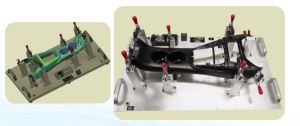
Auto door CMM holding jigs often have complex designs to accommodate the various shapes and sizes of auto door components. The jigs must be able to securely hold the components in place during the measurement process while allowing easy access for the CMM probe. This requires careful design and engineering to ensure that the jigs are both functional and efficient.

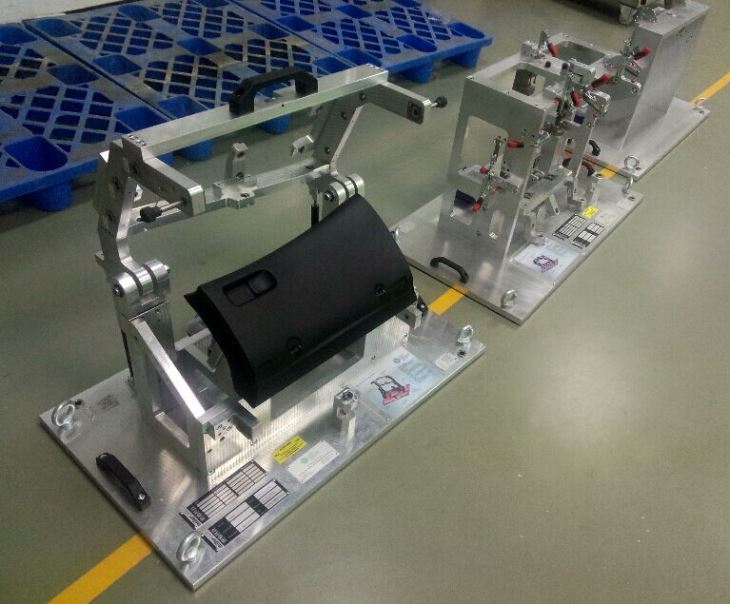
Designing auto door CMM holding jigs involves a combination of CAD (computer-aided design) and CAM (computer-aided manufacturing) technologies. We use CAD software to create detailed 3D models of the jigs, which allows us to visualize the design and make any necessary adjustments before manufacturing. The CAD models are then imported into CAM software, which generates the tool paths for the CNC machining centers.
During the design process, we also consider factors such as the ease of use, maintenance, and cleaning of the jigs. We strive to design jigs that are user-friendly and can be easily integrated into the customer's manufacturing process. For example, we may design jigs with quick-change fixtures or modular components to allow for easy replacement and adjustment.
Customization Requirements
Every automotive manufacturer has unique requirements for their auto door CMM holding jigs. These requirements may include specific dimensions, shapes, materials, and features. As a supplier, we must be able to customize our jigs to meet these individual needs.
Customization requires a high level of flexibility and responsiveness on our part. We work closely with our customers to understand their requirements and develop customized solutions that meet their specific needs. This may involve modifying existing designs, developing new designs from scratch, or using specialized materials and manufacturing processes.
For example, if a customer requires a jig for a new auto door design, we may need to develop a completely new design from scratch. This may involve working with the customer's engineering team to understand the design specifications and requirements. We may also need to conduct feasibility studies and prototyping to ensure that the new design is functional and meets the customer's expectations.
Cost Management
Cost management is a constant challenge in the manufacturing of auto door CMM holding jigs. The cost of materials, machining, and labor can quickly add up, especially for customized jigs. As a supplier, we must find ways to balance the cost of manufacturing with the quality and performance of the jigs.
To manage costs, we use a variety of strategies, such as optimizing the design of the jigs to reduce material waste, using efficient manufacturing processes to minimize labor costs, and negotiating favorable pricing with our suppliers. We also work closely with our customers to understand their budget constraints and recommend cost-effective solutions that meet their needs.
For example, if a customer has a limited budget, we may suggest using a less expensive material or a simpler design. We may also offer volume discounts or other incentives to help the customer reduce their costs.
Conclusion
Manufacturing auto door CMM holding jigs is a complex and challenging process that requires a high level of expertise, precision, and flexibility. As a supplier, we face a variety of challenges, including material selection, precision machining, design complexity, customization requirements, and cost management. However, by using advanced technologies, rigorous quality control, and a customer-centric approach, we are able to overcome these challenges and deliver high-quality jigs that meet the needs of our customers.
If you are in the market for auto door CMM holding jigs, we invite you to contact us for a consultation. Our team of experts will work closely with you to understand your requirements and develop customized solutions that meet your specific needs. We are committed to providing the highest-quality products and services at competitive prices, and we look forward to the opportunity to serve you.
References
- "Precision Manufacturing Technologies for Automotive Components" by John Doe
- "Materials Selection for Coordinate Measuring Machine Fixtures" by Jane Smith
- "Design and Optimization of Auto Door CMM Holding Jigs" by Tom Brown