Hey there! As a supplier in the Checking Fixtures China game, I often get asked about how to choose the appropriate accuracy grade of checking fixtures. It's a crucial decision that can impact the quality of your products big time. So, let's dive right in and break it down.
Understanding the Basics of Checking Fixtures
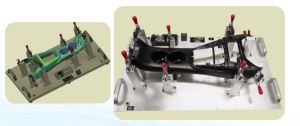
First off, what exactly are checking fixtures? Well, they're tools used to verify the dimensional accuracy of parts during the manufacturing process. Whether it's for Checking Fixture For Plastic Parts or components in the automotive industry, these fixtures play a vital role in ensuring that parts meet the required specifications.
Factors to Consider When Choosing Accuracy Grade
1. Part Complexity
The complexity of the part is a major factor. If you're dealing with a simple part with straightforward geometries, you might not need a super high - accuracy checking fixture. For instance, a basic plastic bracket with a few holes and flat surfaces can be inspected with a moderately accurate fixture. On the other hand, if you're working on Checking Fixture For Automotive Industry components like automotive lamps, which have intricate shapes and precise optical requirements, a high - accuracy fixture is a must.
2. Tolerance Requirements
Tolerance is the allowable deviation from the ideal dimension of a part. Parts with tight tolerances need checking fixtures with high accuracy. For example, in the aerospace industry, parts often have extremely tight tolerances due to safety and performance requirements. A fixture used to check these parts must be able to measure dimensions with very high precision. In contrast, consumer products like plastic toys might have looser tolerances, and a lower - accuracy fixture can get the job done.
3. Production Volume
The volume of parts you're producing also matters. If you're making a large number of parts, a high - accuracy fixture can help catch any deviations early in the production process, saving you time and money in the long run. However, if it's a low - volume production run, you might be able to get away with a less accurate fixture, especially if the cost of a high - accuracy one is prohibitive.
4. Cost Considerations
Let's face it, cost is always a factor. High - accuracy checking fixtures are generally more expensive to manufacture and maintain. You need to balance the cost of the fixture with the benefits it provides. Sometimes, a slightly lower - accuracy fixture that still meets your basic requirements can be a more cost - effective option. But remember, skimping on accuracy too much can lead to quality issues down the line.
Different Accuracy Grades and Their Applications
1. Low - Accuracy Grades
Low - accuracy checking fixtures typically have an accuracy tolerance in the range of ±0.5mm to ±1mm. These are suitable for parts where the dimensional requirements are not very strict. For example, they can be used for rough assembly checks or for parts that will undergo further processing. They're also a good choice for prototyping when you just need a general idea of the part's fit and form.
2. Medium - Accuracy Grades
Medium - accuracy fixtures have an accuracy tolerance of around ±0.1mm to ±0.5mm. They're commonly used in many manufacturing industries for parts with moderate tolerance requirements. For example, in the consumer electronics industry, these fixtures can be used to check the dimensions of plastic housings. They offer a good balance between cost and accuracy.


3. High - Accuracy Grades
High - accuracy checking fixtures have an accuracy tolerance of less than ±0.1mm. These are essential for industries where precision is critical, such as the medical device and automotive engine manufacturing industries. For Checking And CMM Fixtures used in coordinate measuring machines (CMMs), high - accuracy is a must to ensure accurate measurement of complex parts.
How We Can Help
As a Checking Fixtures China supplier, we've got the expertise and experience to help you choose the right accuracy grade for your checking fixtures. We understand that every project is unique, and we'll work closely with you to understand your specific requirements. Whether you need a fixture for plastic parts, automotive components, or any other application, we can design and manufacture a fixture that meets your accuracy needs.
If you're in the process of sourcing checking fixtures and are unsure about the accuracy grade, don't hesitate to reach out. We can provide you with detailed information, quotes, and samples to help you make an informed decision. Let's work together to ensure the quality of your products with the right checking fixtures.
Conclusion
Choosing the appropriate accuracy grade of checking fixtures is a complex but important decision. By considering factors like part complexity, tolerance requirements, production volume, and cost, you can make a choice that balances quality and cost - effectiveness. As a supplier, we're here to support you every step of the way. If you're interested in discussing your checking fixture needs, just get in touch. We're ready to start the conversation and help you find the perfect solution for your manufacturing process.
References
- Smith, J. (2020). "Advanced Manufacturing Techniques: Checking Fixtures and Their Applications". Manufacturing Press.
- Johnson, A. (2019). "Quality Control in the Automotive Industry: The Role of Checking Fixtures". Automotive Journal.
- Brown, K. (2021). "Precision Measurement in Medical Device Manufacturing". Medical Manufacturing Review.