As a supplier of Cupholder CMM holding jigs, one question that frequently arises from our clients is whether these jigs can be used in low - humidity environments. In this blog, we will delve into this topic, exploring the scientific aspects, potential impacts, and performance of Cupholder CMM holding jigs in such conditions.
Understanding Cupholder CMM Holding Jigs
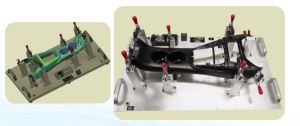
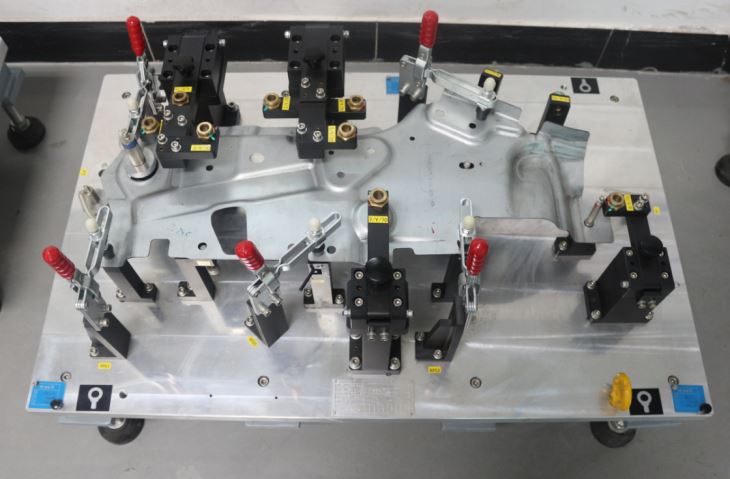
Before we discuss the suitability of Cupholder CMM holding jigs in low - humidity environments, let's briefly understand what these jigs are. A Cupholder CMM (Coordinate Measuring Machine) holding jig is a specialized fixture designed to hold cupholders securely during the measurement process on a CMM. The accurate measurement of cupholders is crucial in the automotive and other industries, as it ensures that the cupholders meet the required specifications and fit properly into the vehicle or equipment.
Our Cupholder CMM Holding Fixture is engineered with high precision, using advanced materials and manufacturing techniques. It is designed to provide stable support and precise positioning of the cupholder, allowing for accurate measurement of its dimensions, shapes, and other geometric features.
Characteristics of Low - Humidity Environments
Low - humidity environments are typically characterized by a relative humidity level below 30%. These environments can be found in various settings, such as deserts, some industrial cleanrooms, and areas with intensive air - conditioning. In such environments, the air contains very little moisture, which can have several effects on materials and equipment.
One of the main impacts of low humidity is on the physical properties of materials. For example, many materials tend to become more brittle in low - humidity conditions. This is because the lack of moisture reduces the flexibility of the material's molecular structure, making it more prone to cracking or breaking under stress. Additionally, low humidity can cause static electricity to build up more easily. Static electricity can attract dust and other contaminants, which may affect the performance of precision equipment like CMM holding jigs.
Effects of Low Humidity on Cupholder CMM Holding Jigs
Material Considerations
The materials used in our Cupholder CMM holding jigs are carefully selected to withstand a wide range of environmental conditions. However, low humidity can still have some effects on these materials.

Most of our jigs are made from metals and polymers. Metals can be relatively stable in low - humidity environments, but they may be more susceptible to corrosion if there are any traces of moisture or contaminants present. For example, if there is a small amount of water vapor in the air, it can react with metal surfaces in the presence of oxygen, leading to the formation of rust. This can not only damage the appearance of the jig but also affect its dimensional accuracy.
Polymers, on the other hand, may experience changes in their mechanical properties. In low - humidity conditions, polymers can become stiffer and more brittle. This can potentially affect the clamping force of the holding jig. If the polymer components of the jig become too brittle, they may crack or break when subjected to the normal forces required to hold the cupholder in place. This could lead to inaccurate positioning of the cupholder during measurement, resulting in measurement errors.
Static Electricity
As mentioned earlier, low humidity promotes the build - up of static electricity. In the context of Cupholder CMM holding jigs, static electricity can be a significant concern. Static charges can attract dust particles and other contaminants to the surface of the jig. These contaminants can interfere with the proper contact between the jig and the cupholder, affecting the measurement accuracy.
Moreover, static electricity can also cause problems during the handling of the jig. If an operator touches the charged jig, the sudden discharge of static electricity can be uncomfortable and may even cause damage to sensitive electronic components in the CMM if there is an electrical connection.
Measurement Accuracy
The ultimate goal of using a Cupholder CMM holding jig is to ensure accurate measurement of the cupholder. Low - humidity conditions can indirectly affect measurement accuracy through the aforementioned material and static - related issues.
If the jig's material properties change due to low humidity, it may not provide the same level of stability and support as it does in normal - humidity conditions. This can lead to slight movements or vibrations of the cupholder during measurement, resulting in inaccurate readings. Additionally, the presence of dust and contaminants on the jig's surface can create small gaps or irregularities between the jig and the cupholder, which can also introduce measurement errors.
Adaptations and Solutions for Low - Humidity Environments
Material Selection and Treatment
To mitigate the effects of low humidity on our Cupholder CMM holding jigs, we have made some adaptations in material selection and treatment. For metal components, we use corrosion - resistant alloys and apply protective coatings to prevent rusting. These coatings act as a barrier between the metal surface and the environment, reducing the risk of corrosion even in the presence of small amounts of moisture.
For polymer components, we select polymers with high flexibility and low moisture sensitivity. Additionally, we can treat these polymers to improve their resistance to low - humidity conditions. For example, some polymers can be impregnated with special additives that enhance their moisture - retention properties, reducing the likelihood of becoming brittle in low - humidity environments.
Anti - Static Measures
To address the issue of static electricity, we incorporate anti - static features into our Cupholder CMM holding jigs. For example, we can use anti - static materials in the construction of the jig or apply anti - static coatings to its surface. These measures help to dissipate static charges, reducing the build - up of static electricity and minimizing the attraction of dust and contaminants.
We also recommend that operators use anti - static tools and wear anti - static clothing when handling the jigs in low - humidity environments. This further reduces the risk of static - related problems.
Environmental Control
In some cases, it may be necessary to control the environmental conditions in the area where the Cupholder CMM holding jigs are used. For example, in industrial cleanrooms, humidity control systems can be installed to maintain a more stable relative humidity level. By keeping the humidity within an appropriate range (e.g., between 30% and 60%), the negative effects of low humidity on the jigs can be minimized.
Performance of Cupholder CMM Holding Jigs in Low - Humidity Environments
Despite the potential challenges posed by low - humidity environments, our Cupholder CMM holding jigs are designed to perform reliably. Through our extensive testing and research, we have found that when the appropriate adaptations and solutions are implemented, the jigs can maintain a high level of accuracy and stability in low - humidity conditions.
In fact, our Auto Metal Parts CMM Holding Fixture, which shares many similar design and material features with the Cupholder CMM holding jig, has been successfully used in some low - humidity industrial environments. The feedback from our clients indicates that with proper maintenance and environmental control, the jigs can meet the measurement requirements and provide consistent performance.
Conclusion
In conclusion, while low - humidity environments can pose some challenges to the performance of Cupholder CMM holding jigs, our products are designed to withstand these conditions. Through careful material selection, anti - static measures, and appropriate environmental control, we can ensure that our jigs provide accurate and reliable measurement support even in low - humidity settings.
If you are in need of a high - quality Cupholder CMM holding jig, whether for use in a low - humidity environment or not, please feel free to contact us for further discussion and procurement. We are committed to providing you with the best - suited solutions for your measurement needs.
References
- "Handbook of Humidity Measurement and Control"
- "Materials Science and Engineering: An Introduction" by William D. Callister Jr. and David G. Rethwisch